01
Validate the PDAA framework
Refine its profile of knowledge, skills and attitudes, its level progression and its relationship with TPACK and AI literacy.
UNIE Universidad
We research how teachers turn their pedagogical knowledge into educational resources and applications using generative artificial intelligence.
Featured call
IGI Global Scientific Publishing · 2027
Our starting point
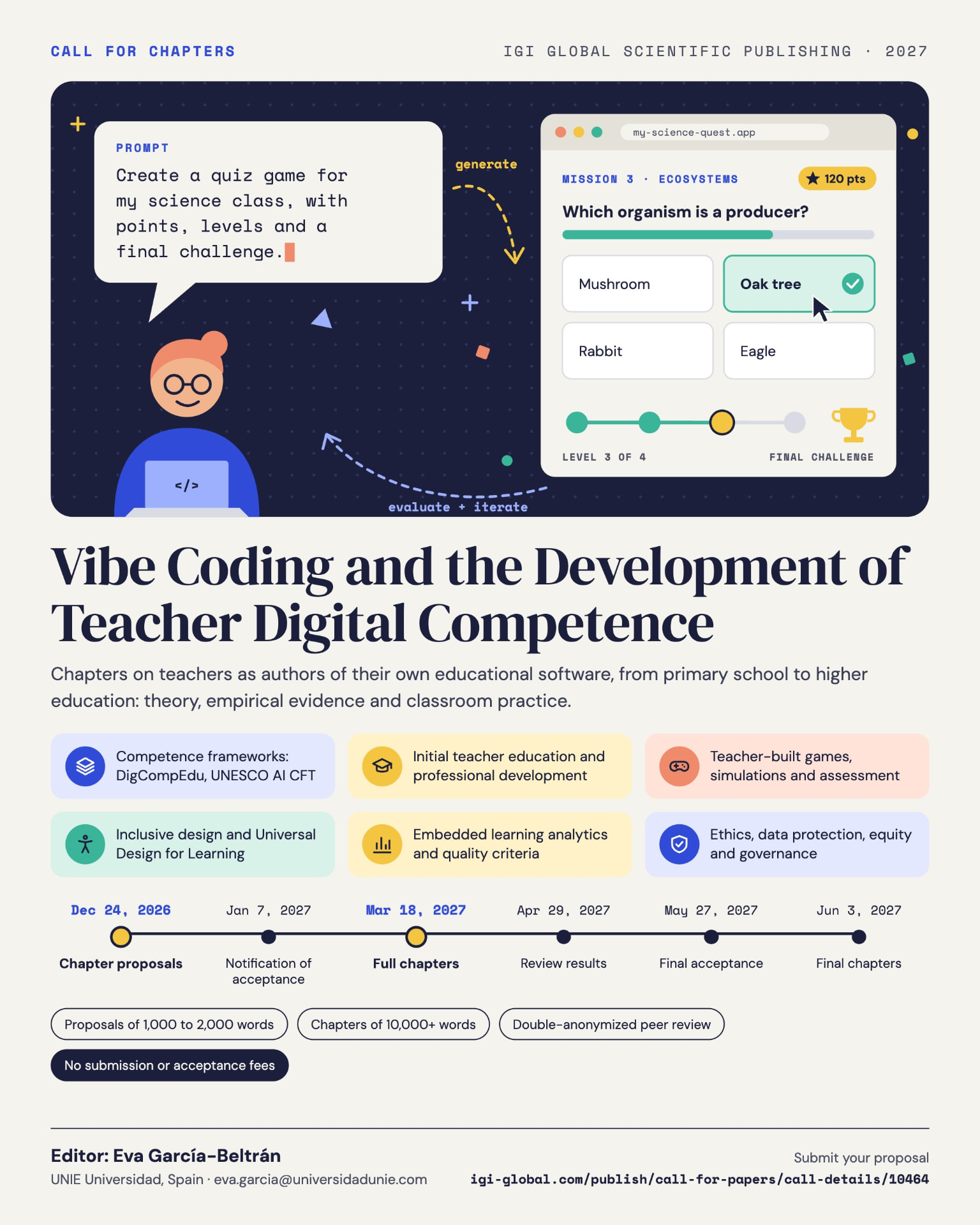
The APIA Group studies the shift from using preconfigured AI tools to creating one's own educational resources by conversing in natural language with generative models, a practice known as vibe coding.
The key is not technical expertise, but the teacher's ability to formulate didactic intent, evaluate what is generated using disciplinary and pedagogical criteria, and iterate until the desired educational quality is achieved.
Core concept
We propose Pedagogically-Driven AI Authorship —PDAA— as a distinct professional competence that current teacher digital competence frameworks do not yet fully capture.
Translate a didactic intent into clear instructions and decisions.
Judge each result from disciplinary and pedagogical knowledge.
Refine the creation until the intended educational quality is reached.
What we aim to achieve
Our overall aim is to conceptualise, assess and develop pedagogically-driven AI authorship as a teacher digital competence in higher education.
Refine its profile of knowledge, skills and attitudes, its level progression and its relationship with TPACK and AI literacy.
Build questionnaires, rubrics and instruments based on observable evidence from the creation process.
Study how teachers specify, evaluate and iterate their creations and share responsibility with platforms.
Evaluate pathways and support tools for university faculty and pre-service teachers.
Promote programmes at UNIE, open guides and scientific dissemination in international journals and networks.
Research · train · transfer
APIA Group · Pedagogically-Driven AI Authorship · UNIE Universidad